Where Greek and Carthaginian Sicily Collided, Twice
Sicily has always been a contested island. It sits dead center in the Mediterranean, close enough to Africa that you can reach it from Cap Bon in a day’s sail and close enough to Italy that you can practically step across from Calabria. Every power that mattered in the ancient world wanted a piece of it: Phoenicians, Greeks, Carthaginians, Romans, and later Arabs, Normans, and Spanish. What happens on Sicily rarely stays on Sicily.
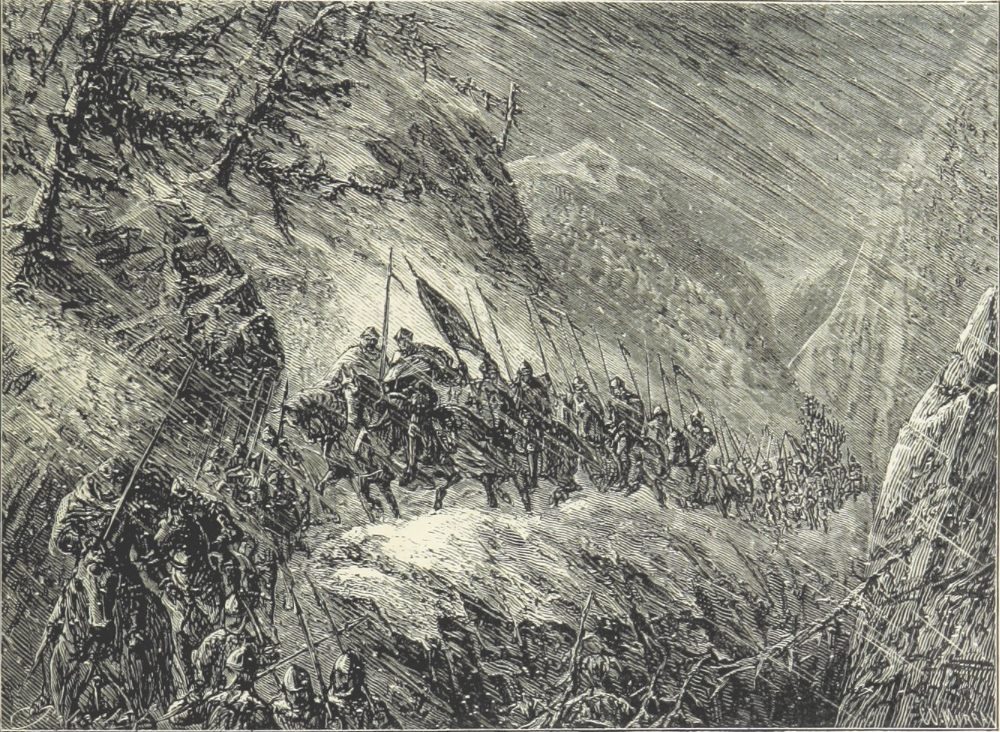
This post is about a stretch of the island’s north coast where two of those civilizations collided head-on, twice in the space of seventy years. The place is Himera, a Greek colony tucked into the hills near modern Termini Imerese. Today the ground around it grows Nero d’Avola and Catarratto. In 480 BCE and again in 409 BCE, it grew corpses.

PART 1: Military History
Sicily at the Edge of Two Worlds
By the middle of the fifth century BCE, Sicily was split more or less down the middle. Greek colonies, most of them founded in the eighth and seventh centuries, lined the eastern and southern coasts: Syracuse, Acragas (modern Agrigento), Gela, Catania, Selinus. Carthaginian and older Phoenician settlements anchored the western end at Motya, Panormus (modern Palermo), and Soloeis. The indigenous Sicels, Sicans, and Elymians held pockets of the interior and the western uplands, usually as clients of whichever power was ascendant at the moment.
Himera sat right on the seam. The city was founded around 648 BCE by colonists from Zancle (modern Messina), reinforced by an exiled Syracusan faction called the Myletidae. That founding date comes from Diodorus, who is the main ancient source for most of what follows. Geographically, Himera was the westernmost Greek city on Sicily’s north coast, which meant it was the first Greek settlement a Carthaginian army moving east from Panormus would run into. That was not a comfortable place to be.
The inland country behind the city rises fast into the Madonie mountains. The coastal plain at Himera is narrow, the ground channels any approaching army into predictable lines, and the low ridges south of the city make perfect positions for anyone who gets there first. It is the kind of terrain that explains why battles kept happening in the same places.
The First Battle of Himera, 480 BCE
Carthage in 480 BCE was not yet the Carthage that would fight Rome. It was already a serious naval and commercial power, with colonies across North Africa, western Sicily, Sardinia, and the Balearics, but the campaigns its generals ran were usually about protecting trade and client cities rather than outright conquest. Its armies were mercenary-heavy: Libyan and Iberian infantry, Balearic slingers, Numidian light horse, all under Carthaginian officers.
The invasion of 480 was led by Hamilcar of the Magonid family, the dominant political clan in Carthage at the time. His pretext was political. Terillus, the tyrant of Himera, had been ousted by Theron of Acragas a few years earlier, and Terillus’s son-in-law Anaxilas of Rhegium appealed to Carthage to put him back. Ancient authors like to emphasize the restoration angle, but the more honest read is that Carthage saw an opportunity and took it.
A quick note on the word “tyrant.” In the Greek world of the fifth century, it did not mean what it means now. A tyrannos was simply a sole ruler who had taken power outside the normal aristocratic or constitutional channels. Some were brutal, some were competent reformers, and some were both. Terillus, Theron, and Gelon were all tyrants in this technical sense. That tells you about how they came to power, not how they governed.
The Greek response came from Gelon of Syracuse, the most powerful man on the island. Gelon had seized Syracuse a few years earlier, built it into a military power on the strength of his heavy infantry and cavalry, and married Theron of Acragas’s daughter. When Theron called for help, Gelon showed up with what Herodotus and Diodorus agree was the largest Greek field army Sicily had yet seen.
The core of that army was the phalanx. A Greek phalanx in 480 was not the professional Macedonian machine that came along in the next century, but it was already a formidable system: ranks of hoplites, each man with an aspis shield on his left arm and a dory spear in his right, packed tight enough that the shield of the man to your right covered half of you. Discipline and cohesion were the whole point. Break the formation and you lost the fight.

The sources disagree on exactly how Gelon won, but the story preserved in Diodorus and picked up by later writers goes like this. Hamilcar was camped near Himera, waiting for cavalry reinforcements from the Sicel town of Selinus. Gelon intercepted the message, and at dawn on the appointed day he sent his own cavalry into the Carthaginian camp disguised as the expected allies. Once inside, they killed Hamilcar (some accounts have him cut down at an altar while sacrificing), set fire to the Carthaginian fleet drawn up on the shore, and signaled Gelon’s main force to attack. The phalanx advanced on a camp that was already leaderless and burning.
The fighting was not clean, and Diodorus says it went on all day, but the outcome was never really in doubt after the camp went up. The Carthaginian army broke, the survivors who made it to the ships found them burning, and most of the rest were killed or taken.
Greek authors loved the coincidence that Himera was fought, according to Herodotus (7.166), on the same day as the naval battle at Salamis. That chronology is almost certainly too neat to be true, but the parallel stuck, and it is where later writers get the idea of calling Himera the “Salamis of the West.” The phrase is a modern label, not an ancient one, but the symbolism it points to is real enough: in the same year, Greek states on both ends of the Mediterranean repelled major invasions, and the story of Greek freedom got its foundation myth on both fronts.
After Himera, Carthage stayed out of Sicily in any serious way for nearly seventy years.
The Second Battle of Himera, 409 BCE
Carthage did not forget. In 409 BCE a Carthaginian army returned to Himera under Hannibal Mago, grandson of the Hamilcar killed in 480. He should not be confused with the Hannibal who crossed the Alps against Rome almost two centuries later, who was a Barcid, not a Magonid. The two men are related only in the broad sense that both came out of Carthage’s military aristocracy.
This campaign was a revenge operation and a land grab at the same time. The immediate trigger was a dispute between Selinus and Segesta in western Sicily. Segesta appealed to Carthage, Carthage obliged, and the expedition that arrived was large enough to make clear that Selinus was not the real target. After sacking Selinus early in the campaign, Hannibal moved his army east along the coast toward Himera.
What the Greeks faced at Himera in 409 was not the force their grandfathers had beaten in 480. It was larger, better supplied, and for the first time in the Greek world it showed up with a real siege train. Diodorus describes battering rams and mobile siege towers, the latter tall enough to overtop the walls of Himera. The common modern claim that Hannibal’s army used torsion catapults at Himera is almost certainly a mistake. Torsion artillery does not appear in the sources until about 399 BCE, when Dionysius I of Syracuse began assembling engineers in Syracuse, and Diodorus explicitly credits that workshop with inventing the weapon. At Himera in 409, the technology was rams and towers, not catapults.
The defenders had help. Syracuse sent a relief force under Diocles, and for several days the Himerans and Syracusans held the walls and even sortied into the Carthaginian lines with some success. Then the relief column got nervous about a rumored Carthaginian naval move against Syracuse itself, and Diocles pulled his men out. Half the civilian population left with them. The rest stayed to defend the walls with what was left of the Himeran levy, and within a few days Hannibal’s engineers broke the wall and his assault columns came through the breach.
What happened next was deliberate. Diodorus (13.62) says Hannibal took three thousand Greek prisoners to the spot where his grandfather Hamilcar had died and had them executed there as a sacrifice. The rest of the adult male population was killed, the women and children enslaved, and the city itself systematically destroyed. Himera was never rebuilt. The survivors were resettled a few kilometers east at a new foundation called Thermae Himeraeae, which is the ancestor of modern Termini Imerese.
What the Graves Showed
For most of the past two thousand years, the Battles of Himera were known only from Diodorus and a handful of other Greek and Roman authors. That changed in the early 2000s. Excavations led by Stefano Vassallo at the western necropolis of Himera uncovered a series of mass graves containing the skeletons of at least sixty-five young adult males, many with weapon trauma consistent with spear and sword wounds, buried in formal rows rather than the usual individual graves of the civic cemetery.
A 2016 paper by Sagnotti and colleagues used archaeomagnetic dating on fired materials from the graves to place one set in the first half of the fifth century BCE and another in the late fifth, aligning neatly with the two battles. Subsequent isotopic and DNA work on the skeletons, published through 2022, has suggested that a significant share of the fighters in the 480 BCE graves were not local Greeks at all, but men whose childhood diets and genetic signatures place their origins in the northern and eastern Mediterranean. That fits with Herodotus and Diodorus’s claim that Gelon’s army drew contingents from across the Greek world, and it is one of the cleaner cases in ancient military archaeology where the bones and the texts confirm each other.
The human remains are still the most direct evidence we have of what these battles actually looked like on the ground.

The Long Road to Rome
The two Battles of Himera were not the end of the Greco-Carthaginian contest for Sicily. They were the opening and the turning point of a war that dragged on for most of the next century and a half, through Dionysius I, Agathocles, and Pyrrhus, and that only ended when Rome stepped in. The First Punic War (264 to 241 BCE) started over a dispute about Messana, less than a hundred kilometers east of Himera’s ruins, and it ended with Sicily becoming Rome’s first overseas province.
Looking back from the Roman period, Himera reads as a preview. The same island, the same Carthaginian enemy, and the same basic pattern of big set-piece battles followed by siege campaigns. Only the Greek piece of the triangle had been replaced.
PART 2: Wine Regions
Italy’s Wine Classification System

Italian wine is regulated by the Ministry of Agriculture, Food Sovereignty and Forestry (Masaf), working through a network of regional consortia (consorzi di tutela) that administer individual appellations. The national framework sits under the EU’s protected-designation umbrella, but Italy retains its own four-tier hierarchy, and that is what you see on the label.
From the top: DOCG (Denominazione di Origine Controllata e Garantita), which is the strictest tier and covers about seventy-seven wines nationally; DOC (Denominazione di Origine Controllata), the main quality tier and home to several hundred appellations; IGT (Indicazione Geografica Tipica), a looser regional category that covers everything from everyday table wine to some of the most celebrated “Super Tuscan” blends; and Vino da Tavola, basic table wine with no geographic claim. DOCG and DOC wines carry strict rules on permitted grapes, yields, alcohol levels, and aging.
Sicily is home to one DOCG (Cerasuolo di Vittoria, in the island’s southeast), twenty-three DOCs, and a single island-wide DOC called Sicilia DOC that overlays most of the others and gives producers a flexible option for blends and single-varietal wines that do not fit a tighter appellation.
The Himera Country: Contea di Sclafani and Sicilia DOC
Terrain and Soil
The ground around ancient Himera is the same ground that feeds a small but interesting stretch of north-central Sicilian vineyard. The coast here is narrow, with the Madonie mountains pressing in from the south and rising to more than 1,900 meters at Pizzo Carbonara. Most vineyards sit in the belt between the sea and the mountains, at elevations from around 200 meters up to 700 or 800 meters on the inland slopes. Soils run heavily to limestone and clay-limestone on the higher ground, with patches of marl and older sedimentary rock in the foothills.
The climate is Mediterranean at the coast and increasingly continental as you climb. What makes the inland elevations interesting for wine is the diurnal shift: hot, dry days followed by cool nights that pull acidity back into the grapes and hold onto the aromatics. That is the same combination that has made the higher slopes of Etna, a hundred and twenty kilometers to the east, the most-watched terroir in Sicily over the past two decades. Contea di Sclafani’s vineyards are not Etna, but they share the same underlying logic: altitude doing the work of latitude.
Grapes Grown
- Whites: Catarratto, Inzolia (also spelled Ansonica), Grillo, Chardonnay.
- Reds: Nero d’Avola, Perricone, Syrah, Cabernet Sauvignon, Merlot.
Wines Produced
Contea di Sclafani DOC covers a cluster of inland communes in the provinces of Palermo, Agrigento, and Caltanissetta, including the hills immediately south of Termini Imerese. It is one of the older inland DOCs on the island, established in 1996. The reds lean on Nero d’Avola and Perricone, the latter a nearly forgotten local variety that has come back into favor over the past twenty years and produces dark, spicy wines with real grip. The whites are built around Catarratto and Inzolia, with occasional Chardonnay from higher-elevation parcels.
Sicilia DOC, established in 2011, is the catch-all island-wide appellation and overlaps most of the Contea di Sclafani footprint. It gives growers the option to label single-varietal Grillo, Catarratto, or Nero d’Avola without committing to the tighter Contea di Sclafani rules. In practice, most serious producers in the Himera country bottle under both, using the broader Sicilia DOC for international varieties and single-grape wines and the narrower Contea di Sclafani DOC for the traditional blends.
Historical Roots
Viticulture on Sicily predates the Greek colonies, though not by much. The Phoenicians were trading wine out of their western Sicilian settlements in the eighth century BCE, and the Greeks brought their own vines and winemaking techniques with them when they founded places like Zancle, Syracuse, and Himera in the eighth and seventh centuries. Himera itself sat on an agricultural hinterland that produced wine, grain, and olive oil for both local consumption and trade.
After Himera’s destruction in 409, the surrounding countryside did not go out of cultivation. Thermae Himeraeae picked up the trade, and under Rome, Sicily as a whole became a bulk producer of wine and grain for the Italian peninsula. The modern wine identity of the north-central coast, built around Nero d’Avola, Perricone, and Catarratto, took shape in the late twentieth century, when a generation of producers in and around Palermo and the Madonie pushed back against the bulk-wine reputation the island had earned in the 1950s and 1960s. The vines are newer than the ruins, but the agricultural continuity between Greek Himera and modern Contea di Sclafani is easier to see here than in most places on the island.
PART 3: Weapon Spotlight
The Dory

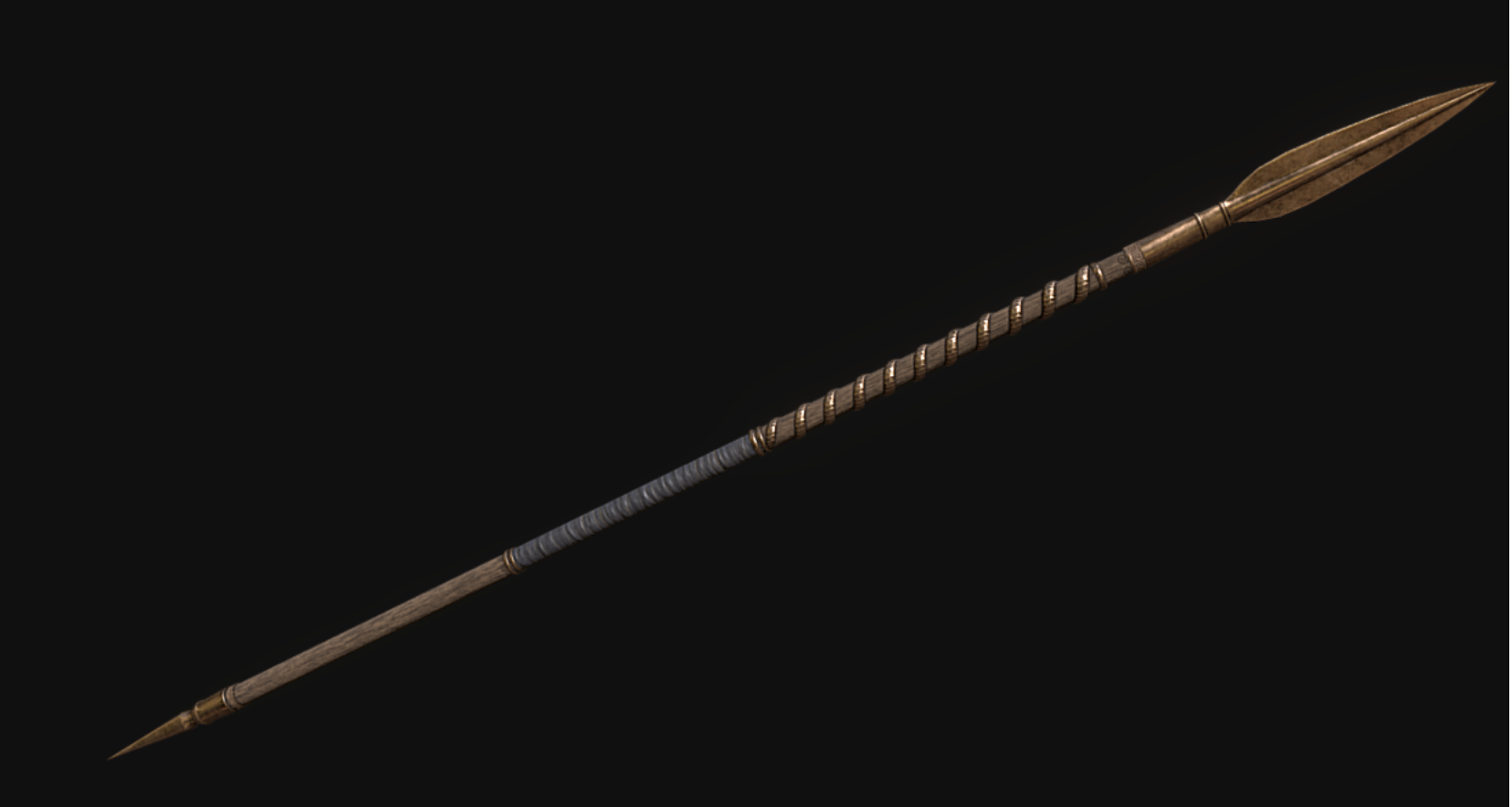
At Himera in 480 BCE, the weapon that did the work of the Greek phalanx was the dory, the standard hoplite spear. It was not a glamorous weapon and it was not a technical marvel. It was a straight wooden shaft, usually ash or cornel wood, between seven and nine feet long, with an iron spearhead on one end and a heavy bronze butt-spike called the sauroter, literally “lizard-sticker,” on the other. Total weight came in somewhere around two to four pounds depending on the wood and the fittings.
What made the dory significant was not the object itself but the formation it enabled. Arranged shoulder to shoulder in a phalanx eight ranks deep, hoplites could present the spears of the first two or three ranks past their own shields, creating a moving wall of iron points that was functionally impossible to rush frontally with lighter troops. At Himera, Gelon’s hoplites used this exact advantage against a Carthaginian mercenary force that was numerous but not organized around anything comparable.
The sauroter on the back end was not decorative. It was a counterweight that let the spear be gripped further back, which extended reach, and it doubled as a secondary point. If the spearhead broke in the first clash, the hoplite could reverse the shaft and keep fighting. It could also be planted in the ground to brace against a cavalry charge, and the rear ranks of a phalanx sometimes used it to finish off enemies on the ground as the formation advanced over them.
Advantages and Disadvantages
The dory’s strengths were the strengths of a formation weapon. In the shield wall, it gave the front-rank hoplite almost three feet of reach beyond his own shield, and the second-rank man could still strike past the first rank’s shoulder. Against an enemy who came at the line frontally, this was a decisive advantage, and it is the main reason Greek heavy infantry consistently beat numerically superior light infantry and mercenary forces for most of the fifth century.
The weaknesses showed up as soon as the formation broke. A single hoplite with a shield on his left arm and a nine-foot spear in his right hand was slow, awkward, and short on personal defense. Once combat went to sword range, the dory became a liability, which is why hoplites also carried a short sword (the xiphos or, later, the kopis) as a secondary weapon. The spear also did not do well in broken terrain, in dense urban fighting, or against light cavalry that could stay at missile range and shoot the phalanx to pieces over time. Most of the famous Greek losses of the fifth century, from Sphacteria to the later stages of the Syracuse expedition, happened when an enemy refused to fight the phalanx on the phalanx’s terms.
At Himera, terrain and Gelon’s own maneuvering solved most of those problems in advance. The camp raid took the Carthaginian army out of formation before the phalanx ever arrived, and by the time the main action opened the fight was already a pursuit. In a straight set-piece the dory might still have won, but it would have cost more.
Legacy
The dory was the parent weapon of an entire tradition. The Macedonian sarissa, the two-handed pike that Philip II and Alexander rode to the conquest of Persia, was essentially a dory stretched to roughly eighteen feet, balanced by a heavier butt-spike and used in a tighter, deeper formation. The Roman legion abandoned the long spear in favor of the pilum and gladius, but it kept the principle of a disciplined heavy infantry line, and Roman auxiliary units continued to use spears of dory-like dimensions well into the imperial period.
Further out, the basic logic of the dory, disciplined heavy infantry with long spears holding a line, shows up again in the Swiss pike squares of the fifteenth century, in the German Landsknechte of the sixteenth, and in the bayoneted musket lines of the eighteenth. Every one of those systems is a variation on a problem the Greeks solved first, and the dory is where the answer started.
Conclusion
Himera is not the most famous battlefield on Sicily, and it is nowhere near the most famous battlefield of the ancient Mediterranean. What it offers, instead, is an unusually clean case of geography shaping history twice. The same stretch of ground between the Madonie and the Tyrrhenian produced two decisive clashes between Greek and Carthaginian Sicily, seventy years apart, and the second one destroyed the city that named the fight.
Today, the ground still produces. The vineyards of Contea di Sclafani and the wider Sicilia DOC sit on the same soils that fed Himera’s grain and grapes in the seventh century BCE. The wines have changed, the grapes have changed, and the political map is no longer Phoenician at one end of the island and Greek at the other. But the agriculture has been continuous, which is worth remembering the next time you open a bottle of Nero d’Avola from the north-central coast. The hills it came from used to be a frontier.
Next in this Sicilian arc: the Sack of Syracuse (212 BCE), the death of Archimedes, and the wines of the island’s southeast.
Sources
Books
- Asheri, David, Alan Lloyd, and Aldo Corcella. A Commentary on Herodotus, Books I-IV. Oxford: Oxford University Press, 2007. (Standard scholarly commentary on the early books of Herodotus, including the Sicilian material on Gelon and the lead-up to the 480 BCE campaign.)
- Diodorus Siculus. Library of History. Translated by C. H. Oldfather. 12 vols. Loeb Classical Library. Cambridge, MA: Harvard University Press, 1933-1967. (Primary ancient narrative source for both Battles of Himera; Book 11 covers 480 BCE, Book 13 covers the 409 BCE sack and the sacrifice of three thousand Greek prisoners.)
- Finley, M. I. Ancient Sicily. Revised edition. London: Chatto and Windus, 1979. (Foundational modern survey of Greek, Carthaginian, and Roman Sicily, with detailed treatment of Himera’s role in the fifth-century Greco-Carthaginian wars.)
- Herodotus. The Histories. Translated by Aubrey de Selincourt, revised by John Marincola. London: Penguin Classics, 2003. (Primary source for the 480 BCE context, including the claim at 7.166 that Himera was fought on the same day as Salamis.)
- Hoyos, Dexter. The Carthaginians. New York: Routledge, 2010. (Modern survey of Carthaginian history covering the Magonid generals, the Sicilian campaigns of 480 and 409, and the army’s mercenary composition.)
- Kagan, Donald, and Gregory Viggiano, eds. Men of Bronze: Hoplite Warfare in Ancient Greece. Princeton: Princeton University Press, 2013. (Essay collection covering hoplite equipment, the phalanx, and the tactical role of the dory in fifth-century warfare.)
- Sabin, Philip, Hans van Wees, and Michael Whitby, eds. The Cambridge History of Greek and Roman Warfare. 2 vols. Cambridge: Cambridge University Press, 2007. (Volume 1 includes chapters on Greek infantry tactics and Carthaginian military organization relevant to both Himera campaigns.)
Websites
- “Battle of Himera (480 BC).” Livius.org. https://www.livius.org/articles/battle/himera-480-bce/ (Narrative account of the first Battle of Himera drawn from Diodorus and Herodotus, with discussion of the Salamis synchronism and Hamilcar’s death.)
- “Battle of Himera (409 BC).” Livius.org. https://www.livius.org/articles/battle/himera-409-bce/ (Account of the 409 BCE sack, including Hannibal Mago’s siege methods and the sacrifice of Greek prisoners.)
- “Himera.” Perseus Digital Library, Tufts University. https://www.perseus.tufts.edu/hopper/text?doc=Perseus:text:1999.04.0006:entry=himera-geo (Reference entry on the site and topography of Himera, including its founding date and the settlement at Thermae Himeraeae after 409 BCE.)
- “Contea di Sclafani DOC.” Italian Wine Central. https://italianwinecentral.com/denomination/contea-di-sclafani-doc/ (Reference entry on the Contea di Sclafani DOC covering grape varieties, permitted wine styles, and the geographic footprint of the appellation.)
- “Sicilia DOC.” Consorzio di Tutela Vini Sicilia DOC. https://www.sicilia-doc.it/ (Official consortium site covering the Sicilia DOC’s regulatory framework, permitted varieties, and member producers.)
Scholarly / Secondary
- Sagnotti, Leonardo, et al. “Archaeomagnetic Dating of Two Ancient Battlefields at Himera (Sicily, Italy).” Proceedings of the National Academy of Sciences 113, no. 47 (2016): 13462-13467. (Archaeomagnetic dating study tying the Himera mass graves to the 480 and 409 BCE battles.)
- Reitsema, Laurie J., et al. “Provisioning an Urban Population: Isotopic Insights from Classical-Period Himera, Sicily.” Journal of Archaeological Science: Reports 39 (2021): 103152. (Isotopic study of Himera skeletal remains examining diet and geographic origin of the city’s population and the men buried in the battle graves.)
- Vassallo, Stefano. “The Necropolises of Himera.” In Sicily: Art and Invention between Greece and Rome, edited by Claire L. Lyons, Michael Bennett, and Clemente Marconi, 54-63. Los Angeles: J. Paul Getty Museum, 2013. (Archaeological report on the western and eastern necropolises of Himera, including the mass graves associated with the two battles.)
Primary Sources
- Diodorus Siculus, Library of History 11.20-26 and 13.59-62 (narratives of the 480 and 409 BCE battles).
- Herodotus, The Histories 7.165-167 (the Sicilian context of 480 BCE and the Salamis synchronism).
- Thucydides, History of the Peloponnesian War 6.5 (on the founding of Himera by Zancleans and Syracusan exiles).