PART 1: Military History
Before the Campaign: Empires, Alliances, and the Ground Between
The Finger Lakes are known today for vineyards, wine trails, and some of the best Riesling produced in North America. I have visited wineries in this region more than once, and each time I am struck by how little the modern experience of the place reveals about what it was before any of those vines went into the ground. Before the Finger Lakes became wine country, this was the agricultural heartland of the Haudenosaunee (Iroquois) Confederacy, and in 1779 the Continental Army marched through it with orders to destroy everything it could reach. The campaign reshaped the region. What followed, over the next several decades, was a transformation from Indigenous homeland to one of the most important wine-producing areas in the United States.
To understand why the Sullivan Campaign happened, we need to go back before the Revolution itself. During the French and Indian War (1754 to 1763), the Haudenosaunee Confederacy occupied a critical position in the struggle between Britain and France for control of North America. For generations, the six nations of the Confederacy had used diplomacy and military leverage to preserve their own autonomy within that imperial rivalry, playing the competing powers against one another to protect their land and influence. British victory in 1763 changed the balance. With France removed from Canada, the old system that had allowed the Haudenosaunee to maneuver between empires began to collapse, and the Confederacy’s strategic position weakened considerably.
That shift had direct consequences for relations among Britain, the colonists, and the Haudenosaunee. The Royal Proclamation of 1763 attempted to limit colonial settlement west of the Appalachians, but colonial demand for land did not stop. British officials soon adjusted the line, and the 1768 Treaty of Fort Stanwix reflected the pressure. That treaty, negotiated in large part by Sir William Johnson (the Crown’s Superintendent of Indian Affairs in the northern colonies), pushed the boundary westward and opened huge tracts of land to colonial speculation and settlement. Land speculators, suffering traders seeking compensation through land grants, and settlers already pushing past the old line all drove the renegotiation. For the Haudenosaunee, the result was clear enough: even when imperial officials spoke of restraint, settler expansion kept moving toward Indigenous land.
That history mattered when the American Revolution began. The Haudenosaunee initially tried to remain neutral, and the Grand Council formally committed to neutrality in 1775. They viewed the conflict as a quarrel between peoples who had long dealt with them but could not be trusted to protect Native sovereignty. The strain of war eventually split the Confederacy, one of the most painful fractures in its history. The Oneida and Tuscarora supported the Americans, while most Mohawk, Seneca, Cayuga, and Onondaga aligned with the British. That division did not come from nowhere. It grew from older alliances with the Crown, frontier trade networks, and a calculation that American settlers posed the more immediate long-term threat to Indigenous land.
By 1777 and 1778, the war on the northern frontier had turned brutal. Raids by Loyalist and Haudenosaunee war parties struck settlements across New York and Pennsylvania, while American retaliation pushed violence deeper into Indigenous country. The fighting no longer resembled conventional campaigning. It became a cycle of attack, reprisal, and deliberate destruction aimed at settlements, food supplies, and civilians as much as armed opponents.
Two attacks in 1778 pushed the Continental leadership toward a major offensive. The Battle of Wyoming (July 3, 1778) in Pennsylvania’s Wyoming Valley, and the Cherry Valley Massacre (November 11, 1778) in central New York, shocked American opinion and convinced Washington and others that the frontier war could not be contained through local defense alone. The main war in the east had settled into a period of limited offensive activity after the Battle of Monmouth in June 1778, and that relative quiet gave Washington the opportunity to commit a large force westward in 1779. The campaign was launched when it was because the frontier crisis had intensified and the broader strategic situation finally made such an expedition possible.
The Sullivan Campaign: March, Battle, and Scorched Earth

In the spring of 1779, George Washington ordered a campaign designed not simply to defeat enemy forces in the field, but to eliminate their ability to operate. His instructions to Major General John Sullivan, dated May 31, 1779, called for “the total destruction and devastation” of the settlements of hostile nations and “the ruin of their crops now in the ground.” The purpose was strategic and punitive at the same time. Washington wanted the frontier threat broken by destroying the towns and food systems that sustained it.
The scale of the force reflected the importance of the mission. Four Continental brigades (under Generals William Maxwell, Edward Hand, Enoch Poor, and James Clinton), totaling about 4,469 men on paper and somewhat fewer once the campaign was fully underway, were assigned to the expedition. Multiple sources describe it as one of the largest Continental operations of the war, involving more than one-third of Washington’s effective field strength at the time.
The campaign unfolded along two main axes. Sullivan advanced north from Easton, Pennsylvania, up the Susquehanna corridor, while James Clinton assembled his brigade in the Mohawk Valley and moved south and west to join him. Clinton’s march was a notable feat of logistics and field engineering. His men gathered boats at Otsego Lake (the source of the Susquehanna), constructed a temporary dam that raised the lake level by roughly two feet, and then breached it to create a surge that made the upper Susquehanna navigable for their bateaux. The soldiers marched along the banks while the boats floated downstream. The two forces linked up at Tioga (near present-day Athens, Pennsylvania) before beginning the main push into the Finger Lakes.
The expedition had already begun its destructive work before the main battle. By early August, Sullivan’s force at Tioga moved against nearby Chemung, burning the settlement. Once the combined army marched on August 26, it entered the Finger Lakes through the Chemung valley, aiming for the Seneca and Cayuga heartland. The opposing British, Loyalist, and Indigenous force could muster only about 600 men to resist the invasion directly.
The principal engagement came at the Battle of Newtown on August 29, 1779. The battlefield sat along the Chemung River near present-day Elmira, New York, at the southern gateway to the Finger Lakes. There, Loyalist rangers and Haudenosaunee defenders under the Mohawk war chief Joseph Brant (Thayendanegea) and the Loyalist commander Captain Walter Butler built concealed breastworks on high ground overlooking Sullivan’s route. Sullivan’s scouts detected the position before the army walked into an ambush. He then pinned the defenders with infantry and artillery fire while sending flanking forces against their line. The position was turned, and the defenders retreated before they could be enveloped. It was the only major pitched battle of the campaign, and it opened the route north into the lake country.

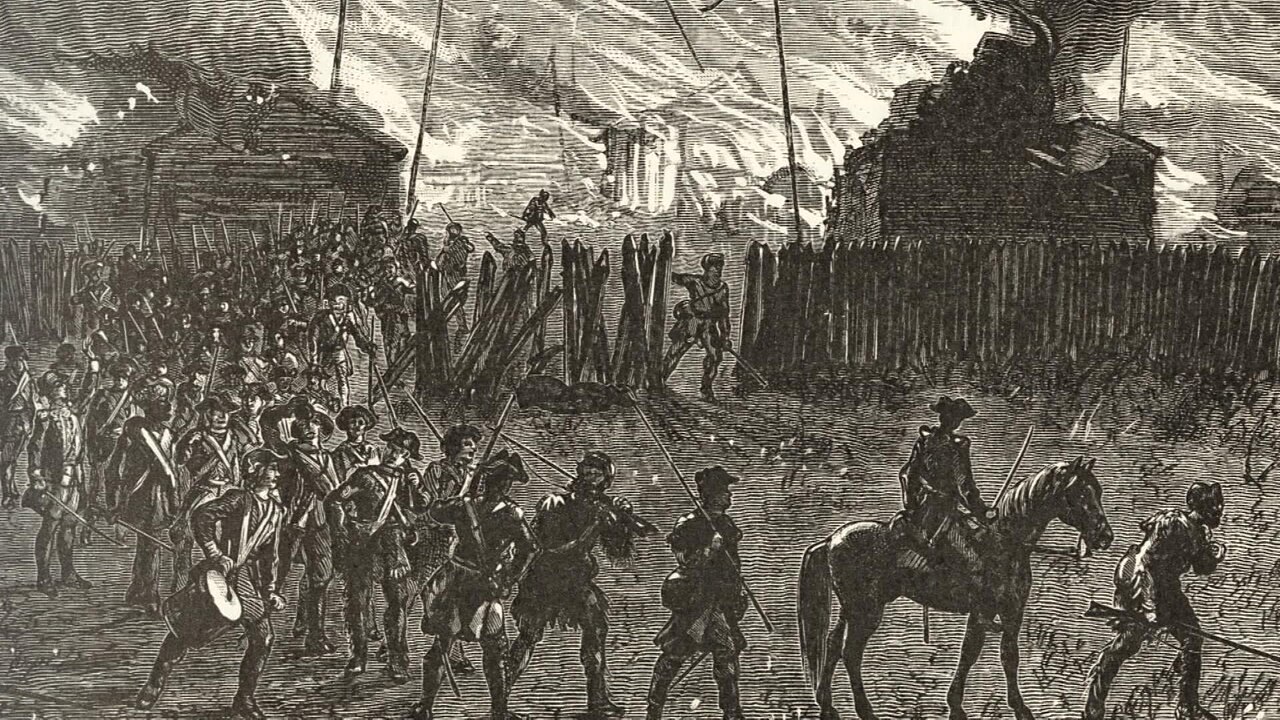
After Newtown, the campaign became one of methodical destruction. Sullivan moved up the east side of Seneca Lake, burning Catharine’s Town near the lake’s southern end (in the area of present-day Watkins Glen). From there the army pushed north toward Kanadaseaga (near present-day Geneva), one of the most important Seneca towns in the region, located between the northern ends of Seneca and Canandaigua lakes. Soldiers recorded not crude encampments but substantial settlements, cultivated fields, and orchards of apple, peach, and cherry. Those, too, were destroyed.
The destruction spread across the wider Finger Lakes basin. Sullivan’s army and its detachments burned settlements in the Seneca Lake corridor, including Kendaia on the west side of the lake, and wrecked major towns around Canandaigua Lake by early September. On the return march, detachments crossed toward Cayuga Lake and destroyed large Cayuga settlements, including Goiogouen and Chonodote, along with smaller villages and fields on both sides of the lake. The campaign did not occupy territory. It moved through it, systematically dismantling the agricultural base that had made the region prosperous and self-sustaining.
The westernmost point came at Chenussio, also known as Little Beard’s Town, on the Genesee River, reached on September 14. By then even the last attempt to check the American advance had failed. On September 13, a scouting party led by Lieutenant Thomas Boyd was ambushed near Chenussio by a force of roughly 400 rangers and warriors. Boyd and a rifleman named Sergeant Michael Parker were captured and later tortured and killed. The loss of Boyd’s patrol did not slow Sullivan’s progress. At Chenussio, the army burned 128 houses and destroyed extensive orchards and fields. Sullivan then turned back east, burning villages that had been missed on the advance.
By the end of the expedition, the army had destroyed more than 40 villages, numerous isolated homes, at least 160,000 bushels of corn, and large quantities of fruit and vegetables. The human consequences were immediate and severe. By September 21, 1779, more than 5,000 Indigenous refugees had gathered around Fort Niagara expecting British support. The campaign did not end frontier warfare, but it shattered the independence of many Haudenosaunee communities by wrecking their food supply and forcing broad dependence on British aid through a brutal winter.
Militarily, the campaign achieved much of what Washington intended. It broke the infrastructure of resistance across the Finger Lakes and opened the region more fully to postwar American settlement. That is the ground beneath the later story of vineyards, wine trails, and the first recorded vineyard planted near Hammondsport in 1829. Before this became a wine region, it was a war-ravaged Indigenous homeland.
PART 2: Wine Region
The American Viticultural Area System

The United States classifies its wine regions through the American Viticultural Area (AVA) system, administered by the Alcohol and Tobacco Tax and Trade Bureau (TTB). An AVA is a federally designated grape-growing region defined by its geographic and climatic characteristics, the features that distinguish it from surrounding areas and affect how grapes develop. The system functions quite differently from European frameworks like France’s AOC or Italy’s DOCG. Those regulate not only geography but also permitted grape varieties, maximum yields, minimum alcohol levels, and aging requirements. The AVA system, by contrast, is purely geographic. It tells you where the grapes were grown, not how the wine was made. If a wine carries an AVA on its label, at least 85 percent of the grapes must have been grown within that designated area.
For this post, the relevant designations are the Finger Lakes AVA (established August 31, 1982), which covers the broad region surrounding all eleven lakes, and two sub-appellations within it: the Cayuga Lake AVA (established 1988) and the Seneca Lake AVA (established 2003). Those sub-appellations recognize the distinct microclimates created by the two deepest and most viticulturally significant lakes in the system.
Finger Lakes: The Cool-Climate Benchmark of the Eastern United States
Terrain and Soil
The defining feature of the Finger Lakes is the lakes themselves. Carved by glacial retreat roughly 10,000 years ago, they are long, narrow, and exceptionally deep, running roughly north to south across upstate New York. These lakes function as thermal regulators, moderating both winter cold and summer heat in ways that make viticulture possible at a latitude where it otherwise would not be. Seneca Lake, the deepest at over 618 feet, exerts the strongest moderating influence and anchors much of the region’s most consistent viticulture. Cayuga Lake, the longest of the Finger Lakes at just under 40 miles, is slightly warmer and supports broader varietal diversity. Keuka Lake, with its distinctive Y-shape, creates steep, well-drained slopes that maximize sun exposure and played a central role in the region’s early winemaking history.
The soils reflect their glacial origin. A mix of shale, gravel, clay, and limestone fragments deposited by retreating glaciers provides excellent drainage while retaining enough moisture to sustain vine growth through dry stretches. These conditions encourage moderate vine stress, the kind that keeps yields in check and concentrates flavors. Combined with a cool continental climate, significant diurnal temperature swings, and a growing season extended by the lakes’ thermal mass, the result is a terroir that rewards varieties capable of retaining natural acidity while developing complex aromatics.
Grapes Grown
Whites:
- Riesling (the benchmark variety, accounting for roughly 46 percent of vinifera acreage), Chardonnay, Gewurztraminer, Pinot Gris
Reds:
- Cabernet Franc (the leading red vinifera), Pinot Noir, Merlot
The region also has a long history with native and hybrid varieties, including Concord, Catawba, Isabella, Cayuga White, Vignoles, and Traminette. These grapes dominated production for over a century before the vinifera revolution of the 1960s, and many vineyards continue to grow them for both table wine and juice production.
Wines Produced
Riesling defines the Finger Lakes today and has become the variety most closely identified with the region’s quality ambitions. The best Finger Lakes Rieslings show clarity, high-toned acidity, mineral expression, and aromatic complexity that place them in serious conversation with leading cool-climate Riesling producers worldwide. The range of styles runs from bone-dry to late-harvest, and the region’s ability to produce across that spectrum reflects how well-suited the grape is to this particular combination of climate and soil.
Chardonnay, both oaked and unoaked, accounts for significant production and ranges from crisp, mineral-driven styles to richer, more textured wines. Cabernet Franc has emerged as the most successful red vinifera variety, producing wines with herbal complexity, bright acidity, and a lighter body well suited to the cool growing conditions. Pinot Noir continues to develop as growers refine site selection, and the variety has become the second most produced red vinifera in the region.
Sparkling wine has a deep history here as well, dating to the mid-nineteenth century, when the Finger Lakes were a center of American sparkling production. Several producers continue that tradition using both traditional method and hybrid varieties.
Historical Roots
Viticulture in the Finger Lakes emerged in the early nineteenth century, following the post-Revolutionary settlement of the region. In 1829, the Reverend William Warner Bostwick planted the first recorded vineyard in Hammondsport, at the southern end of Keuka Lake. From that starting point, grape growing expanded steadily, and by the mid-1800s the Finger Lakes had become a center of American wine production. The region was particularly known for sparkling wines made from native grapes like Catawba and Isabella, and commercial viticulture took hold in earnest after 1862.
The modern identity of the Finger Lakes took shape in the 1950s and 1960s, thanks in large part to Dr. Konstantin Frank, a Ukrainian-born viticulturist who had spent decades working with cold-hardy grape varieties in the Soviet Union before emigrating to the United States. Frank arrived in the Finger Lakes and purchased land on Keuka Lake in 1958, determined to prove that European vinifera grapes could survive the region’s harsh winters if grafted onto the right rootstock. He succeeded. His first commercial vinifera harvest came in the early 1960s, and the work he did at what became Dr. Konstantin Frank Vinifera Wine Cellars transformed the Finger Lakes from a region defined by native varieties into one capable of producing world-class cool-climate wines.
That transformation connects directly to the military history in this post. The Sullivan Campaign of 1779 destroyed the Haudenosaunee agricultural system that had sustained the Finger Lakes for centuries. The postwar settlement that followed brought a new agricultural order, and eventually, a new viticultural tradition. The vineyards that define the region today exist on ground that was cleared by force, resettled by treaty and land sale, and reworked across two centuries of farming. The wine-to-war connection here is not poetic. It is the literal sequence of events.
PART 3: Weapon Spotlight
The American Long Rifle
If I had to pick one weapon that belongs naturally in the Finger Lakes during the Sullivan Campaign, it would be the American long rifle. The fighting across the Finger Lakes in 1779 did not resemble the open-field engagements more commonly associated with the Revolution. This was a campaign conducted through forests, along ridgelines, and across dispersed settlements. Terrain dictated tactics, and tactics favored a weapon built for accuracy over volume.
The long rifle was developed in the backcountry of Pennsylvania, particularly Lancaster County, and the Shenandoah Valley of Virginia during the early eighteenth century. It was the product of German Jäger gunsmithing traditions adapted to the conditions of the American frontier. Its defining feature was the rifled barrel, cut with spiral grooves that imparted spin to the projectile and stabilized the bullet in flight, dramatically improving accuracy compared to the smoothbore muskets carried by most European armies of the period.
In practical terms, a skilled rifleman could engage targets at distances of 200 yards or more under favorable conditions. More typical combat shooting likely fell in the 100 to 150 yard range, but even that represented a significant advantage over the smoothbore musket, whose effective range was generally under 100 yards and often closer to 50 to 75 yards for aimed fire. In the wooded terrain of the Finger Lakes, that difference mattered. Riflemen could engage from cover, target officers or key positions, and disrupt movement before opposing forces could close the distance.
The rifle’s construction reflected its purpose. It was longer and more slender than a standard musket, often with barrels of 40 to 44 inches. That barrel length increased muzzle velocity and contributed to accuracy, while the smaller caliber (typically .40 to .50 caliber) conserved lead and powder, both critical resources on the frontier. Many rifles were individually crafted by gunsmiths, featuring precise rifling, custom-fitted stocks, and iron or brass fittings. No two were exactly alike.
Strengths and Limitations
The long rifle’s greatest advantage was its accuracy, and in the kind of fighting the Sullivan Campaign demanded, accuracy counted for a great deal. The campaign moved through broken, forested country where engagements were often short-range ambushes, skirmishes along trails, or firefights at the edges of settlements. A rifleman who could place a shot accurately at distance, pick off an exposed leader, or pin down a small force from behind cover was worth more than a soldier who could fire three rounds a minute into a formation that did not exist. During the Sullivan Campaign, where the objective was movement through difficult terrain and the destruction of dispersed targets, the rifle aligned well with operational needs.
The limitations were real. Loading a long rifle was significantly slower than loading a smoothbore musket, because the tight-fitting patched ball had to be carefully rammed down the rifled bore. A musket could fire three or four rounds per minute; a rifleman was doing well to manage one or two. The long rifle also lacked a bayonet, which meant it was a serious liability in close combat. In conventional linear warfare, where units advanced in formation and closed with bayonets after delivering volleys, the musket remained the dominant weapon for good reason. The long rifle was not designed for that kind of fight. Its value was in skirmishing, reconnaissance, and irregular engagements, exactly the situations that characterized frontier warfare in the Finger Lakes.
Legacy
The long rifle’s influence extended well beyond the Revolution. It was the first widely used American military weapon that prioritized accuracy over rate of fire, and that emphasis on precision became a recurring theme in American military development. The concept of the trained marksman, a soldier who could select and hit individual targets rather than simply contributing to a volley, traces back in part to the frontier riflemen of the Revolution. Later developments, including the widespread adoption of rifled muskets in the nineteenth century and the emergence of dedicated sharpshooter units during the Civil War, built on the principle that the long rifle had demonstrated: accuracy and range could justify distinct tactical roles and specialized training.
In the Finger Lakes in 1779, the long rifle was a practical tool for a specific kind of campaign. It was shaped by the same terrain and frontier conditions that shaped the people who carried it, and it fit the character of the fighting better than any other weapon in the Continental Army’s inventory.

Conclusion
The Finger Lakes are not the first place most people think of when they think about the American Revolution. The battles that tend to dominate the popular story, Saratoga, Yorktown, Trenton, happened elsewhere. But the Sullivan Campaign of 1779 was one of the largest operations the Continental Army ever mounted, and it was fought across the very ground where Riesling and Cabernet Franc grow today.
What makes this region worth telling in Vini Bellum terms is the directness of the connection. This is not a case where a battle happened near a wine region and I have to work to connect the two. The Sullivan Campaign destroyed the Haudenosaunee agricultural system that had sustained the Finger Lakes for centuries, and the postwar settlement that replaced it eventually produced one of the most important wine regions in the United States. The first vineyard went into the ground at Hammondsport in 1829, just fifty years after Sullivan’s army burned its way through the lake country. The vineyards exist because the campaign happened. That is as direct a wine-to-war connection as I have found in any of these posts.
The long rifle fits the story because it fits the terrain. The Sullivan Campaign was fought through forests and along lakeshores, not across open fields. It rewarded the kind of weapon that could reach out accurately through broken country, and the long rifle did that better than anything else the Americans carried. Like the Finger Lakes themselves, the rifle was a product of the frontier, shaped by the same conditions it was used in.
Today the Finger Lakes produce world-class cool-climate wines from ground that was contested, destroyed, and rebuilt. That history does not make the wine taste different. But it does make the region more worth understanding.
Sources
Books
- Fischer, Joseph R. A Well-Executed Failure: The Sullivan Campaign Against the Iroquois, July-September 1779. Columbia: University of South Carolina Press, 1997. (Comprehensive military history of the campaign, including order of battle, logistics, and the Clinton dam episode.)
- Graymont, Barbara. The Iroquois in the American Revolution. Syracuse: Syracuse University Press, 1972. (Standard account of Haudenosaunee political divisions, neutrality attempts, and the impact of the Sullivan Campaign.)
- Taylor, Alan. The Divided Ground: Indians, Settlers, and the Northern Borderland of the American Revolution. New York: Vintage Books, 2006. (Post-Revolutionary land dispossession, treaty context, and the transformation of the Finger Lakes region.)
- Abler, Thomas S. Cornplanter: Chief Warrior of the Allegany Senecas. Syracuse: Syracuse University Press, 2007. (Seneca perspective on the campaign and its aftermath.)
Primary Sources
- Washington, George. “George Washington to Major General John Sullivan, 31 May 1779.” Founders Online, National Archives. https://founders.archives.gov/documents/Washington/03-20-02-0661 (The original orders calling for “total destruction and devastation” of hostile settlements.)
- Sullivan, John. “Journals of the Military Expedition of Major General John Sullivan Against the Six Nations of Indians in 1779.” Compiled by Frederick Cook. Auburn, NY: Knapp, Peck & Thomson, 1887. (First-person accounts from officers on the campaign, including descriptions of destroyed settlements, corn yields, and the march route.)
Websites
- “The Clinton-Sullivan Campaign of 1779.” National Park Service. https://www.nps.gov/articles/000/the-clinton-sullivan-campaign-of-1779.htm (Overview of the campaign with context on the frontier war.)
- “The Six Nations Confederacy During the American Revolution.” National Park Service. https://www.nps.gov/articles/000/the-six-nations-confederacy-during-the-american-revolution.htm (Haudenosaunee neutrality, the split of the Confederacy, and alliances during the Revolution.)
- “Battle of Newtown.” American Battlefield Trust. https://www.battlefields.org/learn/revolutionary-war/battles/newtown (Battle details, opposing forces, and terrain description.)
- “Treaty of Fort Stanwix, 1768.” National Park Service. https://www.nps.gov/articles/000/1768-boundary-line-treaty-of-fort-stanwix.htm (Context for the 1768 boundary renegotiation and land pressures.)
- “Konstantin’s Story.” Dr. Konstantin Frank Wine Cellars. https://www.drfrankwines.com/konstantins-story/ (Frank’s biography and the vinifera revolution in the Finger Lakes.)
- “Finger Lakes AVA.” Wine-Searcher. https://www.wine-searcher.com/regions-finger+lakes (Regional profile, grape varieties, and production data.)
- “Quick Facts.” Finger Lakes Wine Alliance. https://fingerlakeswinealliance.com/quick-facts/ (AVA establishment dates, varietal acreage, and regional statistics.)
- “AVAs.” Finger Lakes Wine Alliance. https://fingerlakeswinealliance.com/avas-2/ (Sub-appellation details for Cayuga Lake and Seneca Lake AVAs.)
- “American Viticultural Area (AVA).” TTB: Alcohol and Tobacco Tax and Trade Bureau. https://www.ttb.gov/regulated-commodities/beverage-alcohol/wine/american-viticultural-area-ava (Federal AVA regulations and labeling requirements.)
Weapon Sources
- “Revolutionary War Weapons: The American Long Rifle.” Warfare History Network. https://warfarehistorynetwork.com/article/revolutionary-war-weapons-the-american-long-rifle/ (Detailed account of the rifle’s strengths, limitations, and role in the Revolution.)
- “The American Longrifle/Kentucky Rifle Story.” American Longrifles. https://americanlongrifles.org/american-longrifle-kentucky-rifle-story.htm (Construction details, barrel lengths, calibers, and gunsmithing traditions.)