
PART 1: Military History
A Narrow River That Decided a War
Most Americans remember the War of 1812, if they remember it at all, as the war that produced the national anthem and the burning of Washington. That framing misses the place where the war was actually fought hardest. For three years, the decisive ground was a thirty-six mile ribbon of water between Lake Erie and Lake Ontario: the Niagara River. Whoever controlled that river controlled the overland route into Upper Canada, and both sides knew it.
The corridor was small enough to see across and strategic enough to matter. On the American side stood Fort Niagara, a stone-walled post the U.S. had held since 1796. Directly opposite, on the Canadian bank where the river empties into Lake Ontario, stood Fort George, the British regional headquarters and the anchor of their Niagara defenses. The two forts sat within cannon range of each other. The war along this frontier was, in effect, a long argument between them.
By the spring of 1813, the Americans had already lost one major attempt to pry this corridor open. In October 1812, a badly coordinated invasion ended in disaster at Queenston Heights, where British regulars, Canadian militia, and Mohawk warriors under John Norton stopped the first U.S. push cold. After that defeat, American strategy shifted. Instead of rushing the heights again, they decided to bring the war to Fort George itself, using the one advantage they had been building all winter: a growing fleet on Lake Ontario.

The Capture of Fort George, May 27, 1813
The plan was ambitious by the standards of the young U.S. Army. It called for a combined operation: Commodore Isaac Chauncey’s Lake Ontario squadron would land an invasion force on the Canadian beach just west of Fort George, while Fort Niagara’s batteries pounded the British position into rubble from across the river. Major General Henry Dearborn held nominal command. The actual assault was planned and led by his two most capable subordinates, Colonel Winfield Scott (then twenty-six years old and still years away from his brigadier’s star) and Lieutenant Colonel Oliver Hazard Perry, who handled the inshore gunnery work from the schooners.
The bombardment began on May 25. For two days, American gunners at Fort Niagara dropped hot shot into the wooden buildings inside Fort George, setting magazines and barracks on fire and chewing the earthworks apart. By the time the assault went in on the morning of May 27, the fort’s British garrison had already been shelled into a defensive crouch.

Brigadier General John Vincent commanded the defense with about 1,000 British regulars, drawn from the 8th and 49th Regiments of Foot, the Royal Newfoundland Fencibles, and the Glengarry Light Infantry, plus roughly 300 Canadian militia. He was outnumbered at least three to one. Chauncey’s squadron put somewhere between 4,000 and 4,500 American troops into the boats that morning, and Perry’s schooners hammered the shoreline with grape and canister as Scott’s first wave ran up onto the beach.
The landing was contested and ugly. British grenadiers met the first boats at the water’s edge and drove part of Scott’s line back into the surf before American reinforcements forced their way ashore. Scott, wounded in the shoulder by a grenade fragment, kept pushing inland. Within two hours, Vincent recognized that the fort was indefensible and made the call that probably saved his army: he ordered the magazines blown and marched his regulars west toward Burlington Heights, preserving the force that would later counterattack at Stoney Creek and Beaver Dams.
The fort fell by early afternoon. On paper, it was the cleanest American victory of the war so far. In practice, it was far less than it looked. Scott was ready to pursue Vincent and destroy his column, but Dearborn countermanded the order. Vincent escaped with his regiments intact, regrouped, and six days later smashed a pursuing American force at Stoney Creek. By the end of June, the U.S. “conquest” of Upper Canada had collapsed back to the perimeter of Fort George itself.

The Burning of Newark
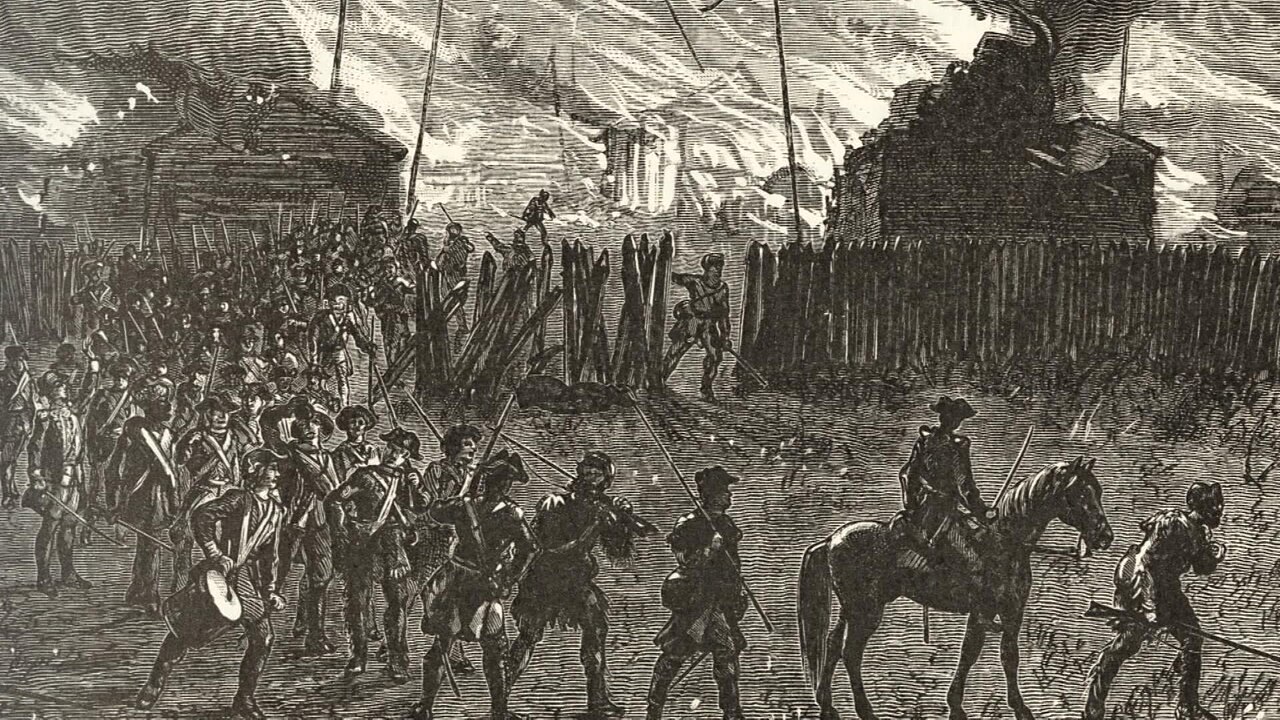
The occupation dragged on through the summer and fall of 1813, with the Americans pinned inside the fort and the British tightening their cordon around it. On December 10, under orders from Brigadier General George McClure, the American garrison abandoned Fort George. Before leaving, McClure’s men burned the adjacent town of Newark (today’s Niagara-on-the-Lake) to the ground. About four hundred civilians, most of them women and children, were turned out into a December snowstorm with what they could carry. McClure justified the decision as a matter of denying winter shelter to the enemy. Almost nobody on either side accepted that reasoning.
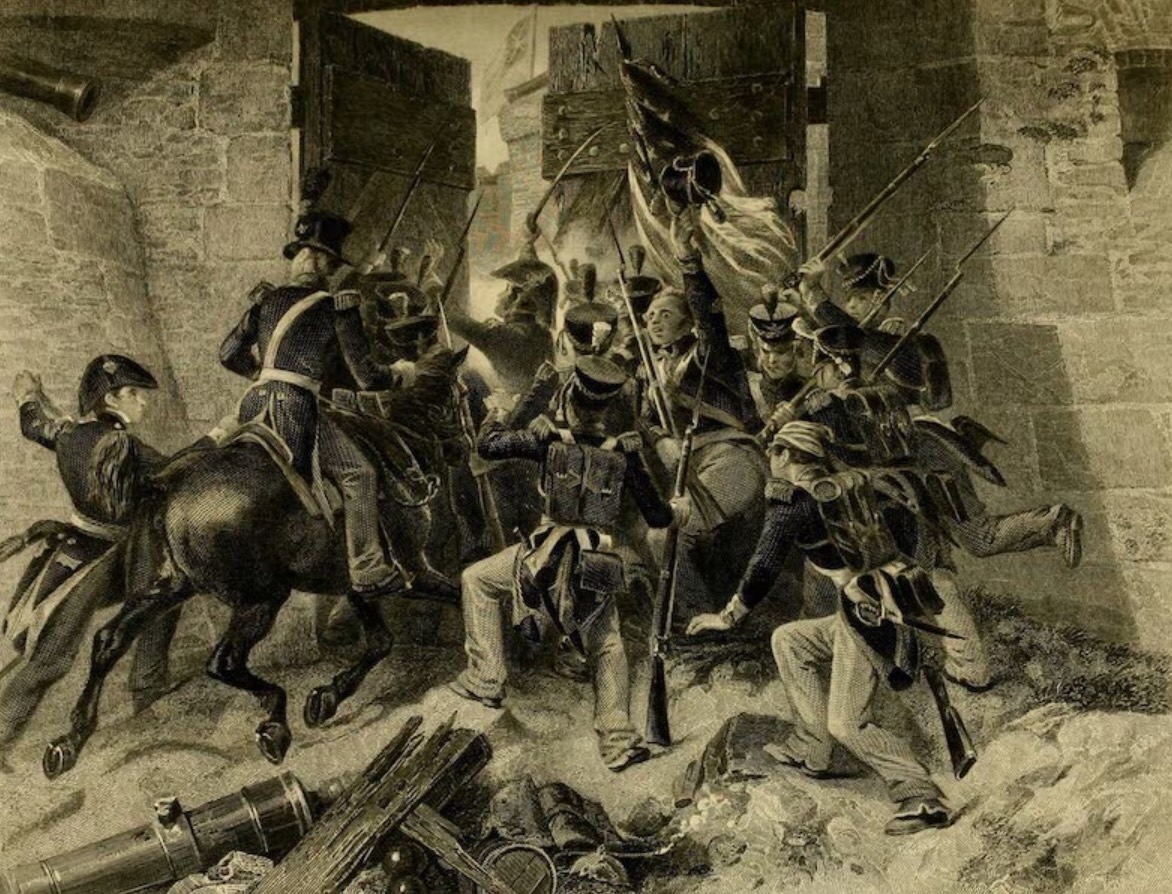
The British response came fast and hard. On the night of December 18-19, British regulars under Colonel John Murray crossed the river, stormed Fort Niagara in a bayonet attack, and took the post along with most of its garrison. Two weeks later, a British column under Major General Phineas Riall burned Black Rock and Buffalo in retaliation for Newark. The Niagara frontier, which had been the most contested ground in the war, became for the winter of 1813-14 the most devastated ground in North America.
That cycle of retaliation (Newark, then Niagara, then Buffalo) is the part of the Fort George story that rarely makes it into the textbooks, and it is the part worth remembering. The war ended in stalemate at Ghent in December 1814. The river frontier did not.
PART 2: Wine Regions
Canada’s VQA System and Designated Viticultural Areas
Canada regulates its fine-wine production through the Vintners Quality Alliance, or VQA, a provincially administered framework that works roughly the way France’s AOC or Italy’s DOC works. The VQA was established in Ontario in 1988 and in British Columbia in 1990, and it is overseen in each province by its own authority (VQA Ontario, and the British Columbia Wine Authority). The system guarantees that a wine labeled VQA is made from one hundred percent Canadian-grown grapes drawn from approved vinifera varieties, produced inside a defined geographic area, and passed through both sensory and laboratory panels before release.
The geographic areas themselves are called Designated Viticultural Areas, or DVAs. Each DVA has legally fixed boundaries, and the more established ones are further broken down into sub-appellations that capture the microclimate differences you get in a place like the Niagara Peninsula, where the lake effect and the Escarpment can change growing conditions over a distance of a few kilometers.
Canada’s international reputation runs heaviest on cool-climate varietals (Riesling, Pinot Noir, Chardonnay) and on Icewine, which the VQA regulates more tightly than almost any other category in the world. Icewine grapes must freeze naturally on the vine at minus eight Celsius or colder, be hand-picked and pressed while still frozen, and hit a minimum sugar concentration before the wine can carry the name. That level of regulation is why Canadian Icewine, and Niagara Icewine in particular, sells at the prices it does.
Niagara-on-the-Lake: Where the War Happened and the Icewine Comes From

Terrain and Soil
Niagara-on-the-Lake sits at the northern edge of the Niagara Peninsula, on a shelf of flat-to-gently-sloping ground that runs from the Niagara Escarpment down to the Lake Ontario shore. The location is what makes it work as a wine region at this latitude. The lake acts as a giant thermal buffer, pulling the fall frost back by weeks and blunting the worst of the winter cold, and the Escarpment traps the lake breeze and recirculates it across the vineyards in a pattern the growers here call the “lake-and-escarpment effect.” The soils are a mosaic left behind by the glaciers: sandy and clay loams over limestone bedrock, with pockets of heavier clay closer to the lake. It is, in the best sense, a patchwork.
Grapes Grown.
- Whites: Riesling, Chardonnay, Sauvignon Blanc, Gewürztraminer, Pinot Gris, Vidal Blanc
- Reds: Pinot Noir, Cabernet Franc, Merlot, Cabernet Sauvignon, Gamay Noir
Wines Produced
The signature wine is Icewine, and the two grapes that carry it are Riesling and Vidal Blanc. A good Niagara Icewine is a contradiction: massive concentrated sweetness balanced by the kind of electric acidity you only get when the water freezes out of the grape and leaves the sugars and acids behind. Beyond Icewine, the region produces serious dry Rieslings (sometimes lean and mineral, sometimes riper and stone-fruited depending on the vintage), oaked and unoaked Chardonnays, and cool-climate Pinot Noir and Cabernet Franc that are closer in spirit to Burgundy and the Loire than to anything warmer. Bordeaux-style reds have improved noticeably over the last two decades as summers have lengthened, but the region’s real identity remains in its whites.
Historical Roots
Commercial wine growing in Niagara goes back to the nineteenth century, but the modern VQA era has a clear starting point. In 1975, Donald Ziraldo and Austrian-born winemaker Karl Kaiser founded Inniskillin near the Niagara River, securing the first new Ontario winery license since the end of Prohibition. Kaiser’s decision to attempt Icewine production in the early 1980s, and the gold medal Inniskillin won for its 1989 Vidal Icewine at Vinexpo in 1991, put Niagara-on-the-Lake on the global wine map and pulled the rest of the Canadian industry forward behind it. Today there are more than twenty wineries inside the Niagara-on-the-Lake sub-appellation alone, most of them clustered within a few minutes’ drive of the battlefield at Fort George.
Niagara Escarpment AVA: The American Counterpart Across the River

Terrain and Soil
The Niagara Escarpment AVA is the less famous sibling, sitting directly across the river in Niagara County, New York. It was designated in 2005, and it shares the same underlying geology as the Canadian side: the limestone ridge of the Escarpment itself, glacial till mixed with clay and loam, and the moderating influence of Lake Ontario. The AVA is small (about eighteen thousand acres) and the vineyards are concentrated on the gentle slopes below the ridge, where drainage is good and the lake effect is strongest.
Grapes Grown
- Whites: Riesling, Chardonnay, Gewürztraminer, Pinot Gris, Vidal Blanc
- Reds: Pinot Noir, Cabernet Franc, Merlot, Baco Noir, Chambourcin
Wines Produced
The New York side produces a similar cool-climate profile to its Canadian counterpart but in smaller quantities and with a different regulatory frame. Riesling is the standout white. Cabernet Franc is the standout red, often with a peppery, herbal edge that suits the climate. Vidal Blanc shows up as both a dry table wine and, when the vintage cooperates, as a late-harvest or ice-style dessert wine. The wineries here tend to be small, family-run, and experimental, working with both vinifera and French-American hybrids.
Historical Roots
Western New York’s grape-growing tradition is older than Ontario’s. Commercial viticulture on the American side of the Niagara began in the mid-nineteenth century, but for most of that history the grapes were Concord and Niagara (the native labrusca varieties), and the product was juice and jelly rather than fine wine. The shift toward vinifera started in the 1970s and 1980s, roughly in parallel with the Ontario renaissance, and the AVA designation in 2005 was a formal recognition that the Niagara Escarpment’s American side deserved to be read on its own terms.
The two sides of the river now produce, in effect, the same wine out of the same geology under two different regulatory systems. You can taste a Riesling from Niagara-on-the-Lake and a Riesling from the Niagara Escarpment AVA side by side and see the shared terroir. You can also, if you like, taste them from the ramparts of Fort George and Fort Niagara respectively, which is a tasting setup I can recommend.
PART 3: Weapon Spotlight: The 24-Pounder Long Gun

The American bombardment that broke Fort George on May 25-27, 1813, was built around one weapon more than any other: the 24-pounder long gun. It was the heaviest piece of smoothbore siege artillery the U.S. Army could drag to the Niagara frontier in 1813, and for a generation on either side of this war it was the gold standard of heavy ordnance in the Atlantic world.
The 24-pounder was an eighteenth-century design. The British Royal Navy had standardized the pattern in the 1750s, and both the French and American services adopted variations of it. The weapon fired a solid iron shot of twenty-four pounds from a smoothbore cast-iron barrel of roughly 5.82 inches in diameter. A typical naval 24-pounder ran about nine and a half feet long and weighed in the neighborhood of 5,500 to 5,800 pounds: a serious piece of iron to manhandle, which is why the guns were usually moved by water when they could be, and why Fort Niagara’s batteries relied on a small number of these big guns rather than a large number of lighter ones.
At Fort George, the American gunners at Fort Niagara loaded their 24-pounders with round shot, hot shot (iron balls heated red in a furnace before loading, designed to set wooden buildings alight), and occasionally grape. The range was roughly three-quarters of a mile across the river, well inside the effective flat-trajectory range of the gun. Over the two-day bombardment, this is the weapon that did the structural damage: it knocked British batteries out of action, set the fort’s wooden barracks and officers’ quarters on fire, and softened the earthworks enough that Scott’s first wave had somewhere to go once they got off the beach.
Advantages and Limitations
The 24-pounder’s advantages were, first and most obviously, the weight of its projectile. A twenty-four pound iron ball at muzzle velocity will punch through almost any wooden fortification built before the widespread adoption of earthwork glacis and masonry revetments, and it will dismount lighter guns if it hits the carriage. Against a fort like Fort George (a log-and-earth structure built quickly in 1796 and only partly upgraded by 1813) the 24-pounder was overmatched to the target, which is exactly why the U.S. chose it.
The limitations were the ones that always came with large smoothbores. The gun was slow: a well-drilled crew could get off maybe one aimed round every two to three minutes, and the barrel needed to cool between sustained volleys or it risked bursting. It was heavy, which made displacement during a battle nearly impossible once the gun was emplaced. And it was inaccurate at long ranges by modern standards: the smoothbore and the solid shot meant the gunner was aiming for the general mass of the target and hoping, rather than picking out individual positions. Across a river like the Niagara, where the range was known and the target was fixed, these limitations mattered less. In a mobile field engagement, they mattered a great deal, which is why the 24-pounder was almost exclusively a siege and naval weapon rather than a field piece.
Legacy
The 24-pounder long gun marked roughly the end of the line for iron smoothbores as the dominant heavy weapon. The generation of artillerists who served on guns like these in the War of 1812 carried their lessons forward into the 1820s and 1830s, and the innovations that followed (John Dahlgren’s bottle-shaped guns in the 1850s, Robert Parker Parrott’s rifled iron pieces, improved metallurgy and better fuses) all took the 24-pounder as their starting point. The gun stayed in frontline service in various forms until the American Civil War, when the shift to rifled artillery made smoothbores obsolete almost overnight. But for the generation of soldiers and sailors who fought the War of 1812, the 24-pounder was the heavy gun, and the capture of Fort George is one of the clearest examples of what it could do when it was pointed at the right target.
Conclusion
Stand on the grass ramparts at Fort George today and you can see three things at once. You can see Fort Niagara across the river, the place where the American gunners lined up their 24-pounders in 1813. You can see the rebuilt town of Niagara-on-the-Lake, burned to the ground by the retreating Americans in December of that same year and now one of the most-visited wine towns in North America. And in the middle distance, you can see the vineyards: Inniskillin, Peller, Jackson-Triggs, Two Sisters, a dozen more, all working the same slice of limestone and clay that the British and Canadian defenders held at bayonet point for most of the war.
The Niagara frontier was the most fought-over ground of the War of 1812. It is also, by a wide margin, the most important wine-producing ground in Canada. That is not a coincidence so much as a product of the same geography: a narrow strip of land, moderated by two great lakes, valuable enough for two empires to burn each other’s towns over it, and now valuable enough to grow some of the best Riesling and Icewine in the Atlantic world. The forts are still standing. The vineyards are still producing. The wine is, in its own way, a memorial.
Sources
Books
- Hickey, Donald R. The War of 1812: A Forgotten Conflict, Bicentennial Edition. Urbana: University of Illinois Press, 2012. (The standard single-volume history of the war, covering causes, campaigns, and consequences, including the Niagara frontier operations of 1813.)
Websites
- “Battlefield of Fort George National Historic Site of Canada.” Parks Canada, Directory of Federal Heritage Designations. https://www.pc.gc.ca/apps/dfhd/page_nhs_eng.aspx?id=1236 (Official Parks Canada heritage designation record for the Fort George battlefield, with summary history and site-significance statement.)
- “The Capture of Fort George, May 27th, 1813.” War of 1812. https://www.warof1812.ca/ftgeorge.htm (Detailed narrative of the American assault, including troop dispositions, naval gunfire support, and the British withdrawal under Vincent.)
- “Case 11: U.S. and British Camps—Niagara Frontier, War of 1812.” In The War of 1812, Clements Library, University of Michigan. https://clements.umich.edu/exhibit/the-war-of-1812/case-11/ (Online exhibit drawing on contemporary manuscripts, maps, and orderly books from the Niagara frontier campaigns.)
- “Fort Niagara.” War of 1812: Battles, American Battlefield Trust. https://www.battlefields.org/learn/war-1812/battles/fort-niagara (Battlefield Trust article on the December 1813 British capture of Fort Niagara following the American burning of Newark.)
- “History of Fort George.” The Friends of Fort George. https://www.friendsoffortgeorge.ca/fort-george/history/index.html (Site-history overview from the preservation group stewarding the Fort George National Historic Site at Niagara-on-the-Lake.)
- “The War of 1812: Niagara Frontier and York – 1813.” Archives of Ontario. https://www.archives.gov.on.ca/en/explore/online/1812/niagara-1813.aspx (Provincial archives resource compiling 1813-campaign documents and images relating to the Niagara frontier and the attack on York.)
- “The War of 1812 on the Niagara River.” Army Historical Foundation. https://armyhistory.org/the-war-of-1812-on-the-niagara-river/ (Overview essay on the strategic importance of the Niagara corridor and the major engagements fought along it between 1812 and 1814.)